Dental Filling Treatment at The Master Dentist
A dental filling removes tooth decay and seals the cavity with a tooth-coloured or silver material, so the tooth works normally again. Tooth-coloured fillings also blend in with the natural tooth. It suits children and adults with cavities, small chips or broken old fillings. Book a filling appointment at The Master Dentist, Islamabad.
A dental filling is a restorative dental treatment that removes decay and fills the cavity with composite resin, amalgam or glass ionomer cement. The dentist numbs the tooth, removes the decay, shapes the cavity and places the filling material. The procedure has 7 steps and takes 20–90 minutes per tooth, depending on the cavity size and material. You return to work the same day. Numbness wears off in 2–3 hours.
Dental fillings at The Master Dentist are placed by Dr. Asad Nawaz Baloch, BDS, RDS (School of Dentistry, SZABMU, Islamabad), Dental Surgeon.
Quick Facts
| Fact | Detail |
|---|---|
| Procedure Cost | PKR 2,000–10,000 per tooth, depending on material (Islamabad range) |
| Procedure Time | 20–90 minutes per tooth |
| Anaesthesia | Local anaesthesia |
| Visits | 1 for direct fillings; 2 for inlays and onlays |
| Recovery | Same day; numbness lasts 2–3 hours |
| Results Last | Composite about 11 years; amalgam over 16 years (median, back teeth) |
What Is the Price of a Dental Filling at The Master Dentist Islamabad?
A dental filling in Islamabad costs PKR 2,000 to PKR 10,000 per tooth, depending on the material. A tooth-coloured composite filling costs PKR 5,000–10,000. A silver amalgam filling costs PKR 2,000–5,000, and a glass ionomer filling costs PKR 2,500–4,000. Each filling is priced by its size and material, so the total for 2 or more fillings depends on each tooth.
The 5 factors that affect the dental filling cost are listed below:
- Filling material: composite costs more than amalgam or glass ionomer.
- Cavity size: larger cavities covering more tooth surfaces cost more.
- Tooth position: front-tooth composite fillings take longer because of layering and shade matching.
- Extra support: a liner or retention pins add to the cost.
- Dental X-ray: an X-ray is needed when decay sits between the teeth.
| Dental Filling Type | Duration | Cost per Tooth in Islamabad (PKR) |
|---|---|---|
| Consultation | 15–20 minutes | 500–3,000 |
| Composite (Tooth-Coloured) Filling | 30–60 minutes | 5,000–10,000 |
| Amalgam (Silver) Filling | 20–40 minutes | 2,000–5,000 |
| Glass Ionomer (GIC) Filling | 15–30 minutes | 2,500–4,000 |
| Pin-Retained Filling | Depends on cavity size | From 5,000 |
Prices are typical Islamabad market ranges from clinic and directory listings (November 2026). The Master Dentist confirms the exact price after the examination.
Who Needs a Dental Filling?
A dental filling is needed when a tooth has a cavity, a small chip or a broken old filling. The 8 signs that you need a filling are listed below:
- Cavity on X-ray: decay found at a check-up, often before any pain.
- Sensitivity: a sharp twinge with sweet, hot or cold food.
- Visible hole: a hole or dark spot on the tooth surface.
- Food trapping: food getting stuck in one tooth.
- Small chip: a chipped or cracked edge with limited damage.
- Worn surfaces: worn areas near the gum line.
- Old filling: a broken, cracked or leaking filling.
- Children’s cavities: decay in milk teeth or new permanent teeth.
Early cavities are often painless. A filling at this stage keeps the repair small.
When Is a Filling Not Enough?
A filling is not enough when decay reaches the nerve or most of the tooth is lost. The 4 situations that need a different treatment are listed below:
- Decay in the nerve: root canal treatment, then a filling or crown.
- More than half the tooth lost: a crown or ceramic onlay.
- A crack through the tooth: a crown, or extraction if the crack reaches the root.
- Swelling or severe pain on biting: an urgent assessment for infection.
A filling costs less and takes less time than a root canal. Treating a cavity early can avoid the need for a root canal.
How to Prepare for a Dental Filling?
To prepare for a dental filling, share your medical history, eat a light meal, and brush your teeth before the appointment. The 6 preparation steps are listed below:
- Share your medical history and medicines.
- Tell the dentist if you are pregnant before any X-ray.
- Mention any allergy to local anaesthetic or metals.
- Eat a light meal, as you cannot eat until the numbness wears off.
- Brush and floss before the visit.
- Ask about a tooth-coloured filling for front teeth.
How Is a Dental Filling Done at The Master Dentist Islamabad?
A dental filling is done in 7 steps over 20–90 minutes per tooth. Composite fillings take the longest because the material is placed in layers.
Step 1: Examination and Dental X-ray
The dental surgeon checks the tooth and takes an X-ray when decay sits between teeth or near the nerve.
Step 2: Local Anaesthesia
Local anaesthetic numbs the tooth and nearby gum. Small, shallow cavities sometimes need no injection.
Step 3: Decay Removal
A dental drill and hand instruments remove the soft, decayed tooth structure.
Step 4: Cavity Cleaning, Shaping and Liner
The cavity is cleaned and shaped to hold the filling. A protective liner goes in deep cavities close to the nerve.
Step 5: Etching and Bonding Agent
For composite fillings, the tooth is etched and coated with a bonding agent. Amalgam and glass ionomer skip this step.
Step 6: Layered Filling and Light Curing
Composite is placed in thin layers of 1–2 mm. A blue curing light hardens each layer. Amalgam is condensed into the cavity in small increments.
Step 7: Bite Check, Shaping and Polishing
The dentist checks the bite with articulating paper, adjusts high spots and polishes the filling.
What Is the Aftercare After a Dental Filling?
Dental filling aftercare is avoiding food until the numbness wears off, brushing twice daily, and returning if the bite feels high. The 7 aftercare instructions are listed below:
- Avoid eating until the numbness wears off, after 2–3 hours.
- Avoid chewing hard food on a new amalgam filling for 24 hours.
- Avoid very hot or cold food for a few days if the tooth feels sensitive.
- Use a sensitivity toothpaste if sensitivity continues.
- Brush twice daily with fluoride toothpaste and floss once daily.
- Return to the clinic if the bite feels high or uneven.
- Attend a check-up every 6 months.
A composite filling is fully hard before you leave the chair. You can eat on it once the numbness has gone.
Which Types of Dental Fillings Are Offered at The Master Dentist Islamabad?
The Master Dentist offers 5 types of dental fillings: composite, amalgam, glass ionomer, temporary fillings, and ceramic inlays or onlays.
| Type | Material | Best For | Visits |
|---|---|---|---|
| Composite (Tooth-Coloured) | Resin with glass fillers | Front teeth and visible back teeth | 1 |
| Amalgam (Silver) | Silver, tin, copper and mercury alloy | Large back-tooth cavities | 1 |
| Glass Ionomer (GIC) | Glass powder and acid liquid; releases fluoride | Cavities near the gum line and children’s teeth | 1 |
| Temporary Filling | Soft temporary cement | Between root canal visits or before a crown | 1 |
| Ceramic Inlay or Onlay | Lab-made porcelain piece | Large cavities that do not need a full crown | 2 |
Fillings differ in colour, strength, lifespan, number of visits and cost.
How Long Does a Dental Filling Take?
A dental filling takes 20–90 minutes per tooth, depending on the material and cavity size.
| Filling Type | Chair Time | Visits |
|---|---|---|
| Composite | 30–90 minutes | 1 |
| Amalgam | 20–40 minutes | 1 |
| Glass Ionomer | 15–30 minutes | 1 |
| Ceramic Inlay or Onlay | 2 appointments | 2 |
Several fillings can be done in one visit.
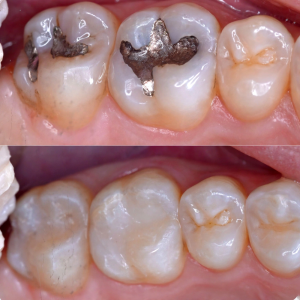
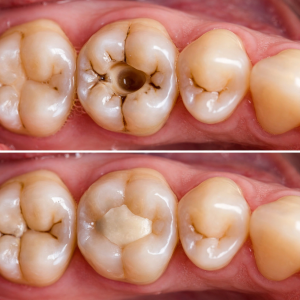
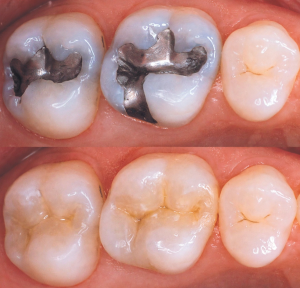
Dental Filling Before and After
Results vary from person to person.
How Long Do Dental Fillings Last?
Dental fillings last about 11 years for composite and over 16 years for amalgam (median survival in back teeth), according to a 2025 systematic review in Cureus. A 2021 Cochrane review of randomised trials also found composite may fail about twice as often as amalgam in back teeth, based on low-certainty evidence. A 2015 meta-analysis by Moraschini and colleagues in the Journal of Dentistry found a mean annual failure rate of 1.71% for amalgam and 3.17% for composite. Glass ionomer is weaker under chewing load and suits low-stress areas.
The 4 factors that shorten filling life are new decay at the filling edges, teeth grinding, very large fillings and poor oral hygiene.
What Are the Benefits of Dental Fillings?
The 10 benefits of dental fillings are listed below:
- Stops decay: removing decay prevents it spreading deeper.
- Relieves sensitivity: sealing the cavity reduces sharp twinges.
- Restores chewing: the tooth bites normally again.
- Natural look: composite matches the shade of the tooth.
- Keeps the natural tooth: most of the original tooth stays.
- Helps avoid bigger treatment: an early filling helps avoid root canal or extraction.
- Single visit: most fillings take 1 appointment.
- Affordable: a filling costs PKR 2,000–10,000 per tooth in Islamabad.
- Fluoride release: glass ionomer releases fluoride into the tooth.
- Repairs chips: composite rebuilds small chipped edges.
What Are the Side Effects of a Dental Filling?
The 3 most common side effects of a dental filling are sensitivity to hot and cold for a few days to 2 weeks, soreness at the injection site for 1–2 days and a high bite. The 4 rare effects are listed below:
- Persistent pain: pain that lasts weeks can mean the nerve is inflamed.
- Allergy: a rare reaction to amalgam metals.
- Chipped or lost filling: from biting hard objects or grinding.
- New decay: decay at the filling edges over time.
Contact your dental surgeon if pain lasts more than 2 weeks or the bite still feels high after 2 days.
Composite vs Amalgam vs GIC vs Inlay – Which Filling Is Better?
The better filling depends on the tooth position, cavity size and budget. Composite suits visible teeth, amalgam suits large back-tooth cavities, and glass ionomer suits low-stress areas.
| Factor | Composite | Amalgam | Glass Ionomer | Ceramic Inlay/Onlay |
|---|---|---|---|---|
| Colour | Tooth-coloured | Silver | Tooth-coloured, less translucent | Tooth-coloured |
| Best for | Front and visible teeth | Large back-tooth cavities | Gum-line cavities, children | Large cavities without a crown |
| Strength | Good | Very good | Low under chewing load | Very good |
| Lifespan | About 11 years (median) | Over 16 years (median) | Shorter in chewing areas | Not consistently longer than composite |
| Visits | 1 | 1 | 1 | 2 |
| Cost range (PKR) | 5,000–10,000 | 2,000–5,000 | 2,500–4,000 | Quoted per tooth |
A 2021 Cochrane review found low-certainty evidence that composite fillings may fail about twice as often as amalgam in back teeth. Composite materials have improved since those trials.
Why Choose The Master Dentist Islamabad for Dental Fillings?
The Master Dentist examines the tooth and explains the filling options before treatment starts. The 6 reasons patients choose The Master Dentist for fillings are listed below:
- Qualified dental surgeon: Dr. Asad Nawaz Baloch, BDS, RDS (School of Dentistry, SZABMU, Islamabad).
- Examination first: an X-ray when decay sits between teeth or near the nerve.
- Choice of materials: composite, amalgam, glass ionomer or ceramic.
- Comfort: local anaesthesia for the procedure.
- Bite check: the bite is checked with articulating paper and the filling polished.
- Follow-up: 6-monthly check-ups to catch new decay early.
Dental Surgeon for Dental Fillings at The Master Dentist Islamabad
Dr. Asad Nawaz Baloch – Dental Surgeon at The Master Dentist
Dr. Asad Nawaz Baloch is a dedicated and compassionate Dental Surgeon at The Master Dentist, committed to delivering quality dental care through a patient-centered approach. He holds a Bachelor of Dental Surgery (B.D.S.) degree and has completed his Residency in Dental Surgery (R.D.S.) from the prestigious School of Dentistry, Shaheed Zulfiqar Ali Bhutto Medical University (SZABMU), Islamabad.
With a strong academic foundation and specialized clinical training, Dr. Asad Nawaz Baloch brings extensive dental knowledge and a comprehensive understanding of oral healthcare. He focuses on carefully evaluating each patient’s dental concerns, recommending appropriate treatment options, and providing care with professionalism, precision, and attention to detail.
His approach combines clinical knowledge with a genuine commitment to patient comfort, clear communication, and personalized treatment planning. At The Master Dentist, he strives to help patients maintain healthier smiles and enjoy a comfortable, reassuring dental care experience.
Book a Dental Filling in Islamabad
Book a dental filling appointment at The Master Dentist, Islamabad. The appointment includes an oral examination, an X-ray if needed and a written treatment plan with cost. Call +92 340 5599322 or message us on WhatsApp.
Dental Filling FAQs
Is a front tooth filling painful?
A front tooth filling is not painful during treatment because local anaesthesia numbs the tooth. Small front-tooth repairs sometimes need no injection.
Do I need a filling if I have no pain?
It depends on the depth of the decay. A cavity that reaches the dentine needs a filling even without pain because it keeps spreading. Early enamel-only decay can sometimes be remineralised with fluoride and monitored.
Can I eat right after a filling?
Yes, you can eat after a composite filling once the numbness wears off, after 2–3 hours. Avoid chewing hard food on a new amalgam filling for 24 hours.
Is a filling better than a root canal?
A filling is better when the decay has not reached the nerve. Once the nerve is infected, a root canal is needed to save the tooth.
Which is more painful, a filling or a root canal?
Both use local anaesthesia, so discomfort during treatment is limited and varies by patient. A root canal takes longer and can leave more soreness for a few days.
Which filling material is best?
The best filling material is composite for visible teeth and amalgam or composite for large back-tooth cavities. The choice depends on position, size and budget.
Is a dental filling permanent?
No, a dental filling is not permanent because fillings wear and new decay can form at the edges. Composite lasts about 11 years and amalgam over 16 years (median).
Can a filling fall out?
Yes, a filling can fall out when new decay forms underneath or you bite something hard. Book a visit soon to protect the exposed tooth.
Is amalgam filling safe?
Amalgam fillings are considered safe for most adults because the mercury is bound in a stable alloy. A 2021 Cochrane review found no clear safety difference from composite, but that evidence is very low certainty. Some countries restrict amalgam in children and pregnant women.
Why is tooth filling costly?
A tooth filling costs more than expected because the price covers the examination, anaesthesia, materials, bonding agents and chair time. Composite takes longer to layer and shade-match than amalgam.
Can I get a filling during pregnancy?
Yes, you can get a filling during pregnancy, ideally in the second trimester. Tell the dentist you are pregnant before any X-ray.
Can children get fillings?
Yes, children can get fillings because cavities in milk teeth cause pain and infection. Glass ionomer suits children because it releases fluoride.
Is 3 fillings a lot?
No, 3 fillings are not unusual because cavities often form in several back teeth at once. Regular check-ups catch them while they are small.
What is the 2-2-2 rule for teeth?
The 2-2-2 rule is brushing 2 times a day, for 2 minutes each time, and visiting the dentist 2 times a year.
Can a filling fix a chipped front tooth?
Yes, a composite filling can fix a small chip on a front tooth in one visit. Large chips need a veneer or crown.
Why does my filled tooth hurt when I bite?
A filled tooth hurts on biting because the filling sits slightly high. A quick adjustment at the clinic fixes it.
Can fillings cause bad breath?
No, a sound filling does not cause bad breath. A cracked or leaking filling traps food and bacteria, which causes odour and needs replacement.