Dental Implant Treatment at The Master Dentist
A dental implant replaces a missing tooth with an artificial titanium or zirconia root and a fixed crown that restores the look and chewing function of the tooth. It suits adults with healthy gums and enough jawbone. Book an implant assessment at The Master Dentist, Islamabad.
A dental implant is a titanium fixture placed in the jawbone that replaces a tooth root and supports a crown, bridge or denture. The bone fuses with the titanium surface in a process called osseointegration. The procedure has 8 steps across 3 stages: planning, implant placement and crown fitting. Return to desk work takes 1–2 days for a single implant without a graft. The final tooth is fitted after 3–6 months of bone healing.
Dental implant treatment at The Master Dentist is led by Dr. Asad Nawaz Baloch, BDS, RDS (School of Dentistry, SZABMU, Islamabad), Dental Surgeon.
Quick Facts
| Fact | Detail |
|---|---|
| Procedure Cost | PKR 100,000–370,000 per single implant with crown (Islamabad range) |
| Procedure Time | 45–60 minutes per implant |
| Anaesthesia | Local anaesthesia |
| Healing Before Crown | 3–6 months |
| Return to Work | 1–2 days (single implant, no graft) |
| Results Last | 96.4% of implants survive 10 years; crown lasts 10–15 years |
What Is the Price of a Dental Implant at The Master Dentist Islamabad?
A single dental implant with crown in Islamabad costs PKR 100,000 to PKR 370,000, including the implant, abutment and crown. Korean implant systems cost PKR 100,000–180,000, and Swiss or US systems cost PKR 180,000–370,000. A full-arch All-on-4 costs PKR 280,000–1,200,000 per jaw. The Master Dentist gives a written quote after the examination and scan. The quote lists the implant, abutment, crown, any bone graft and follow-up visits.
The 5 factors that affect the dental implant cost are listed below:
- Implant system: Korean systems (DIO, Osstem) cost less than Swiss and US systems (Straumann, BioHorizons).
- Number of implants: a 3-tooth bridge needs 2 implants; a full arch needs 4–6 implants.
- Bone grafting: a bone graft or sinus lift adds cost when the jawbone is too thin.
- Crown material: zirconia and E-max crowns cost more than porcelain-fused-to-metal (PFM) crowns.
- Temporary teeth: a temporary crown or fixed temporary bridge during healing adds to the total cost.
| Dental Implant Treatment | Duration | Cost in Islamabad (PKR) |
|---|---|---|
| Dental Consultation | 20–30 minutes | 500–3,000 |
| Single Tooth Implant with Crown (Korean system, e.g. Osstem, Dentium, DIO) | 3–6 months total | 100,000–180,000 |
| Single Tooth Implant with Crown (Swiss/US system, e.g. Straumann, BioHorizons) | 3–6 months total | 180,000–370,000 |
| Implant Crown Only | 1–3 weeks | 20,000–100,000 |
| Implant-Supported Bridge (2 implants, 3 teeth) | 3–6 months total | 180,000–280,000 |
| All-on-4 Full Arch (per jaw) | Fixed temporary teeth on day 1 in suitable cases; final bridge in 3–6 months | 280,000–1,200,000 |
| All-on-6 Full Arch (per jaw) | Fixed temporary teeth on day 1 in suitable cases; final bridge in 3–6 months | 420,000–660,000 |
| Full Mouth Implants (both jaws) | 3–6 months | 900,000–2,500,000 |
| Bone Graft (add-on) | Case-dependent; a separate graft adds 3–6 months | 20,000–120,000 |
| Sinus Lift (add-on) | Case-dependent; a separate sinus lift adds 3–6 months | 25,000–100,000 |
Prices are typical Islamabad market ranges from clinic and directory listings (November 2026). The Master Dentist confirms the exact price in a written quote after the examination.
How Does a Dental Implant Work?
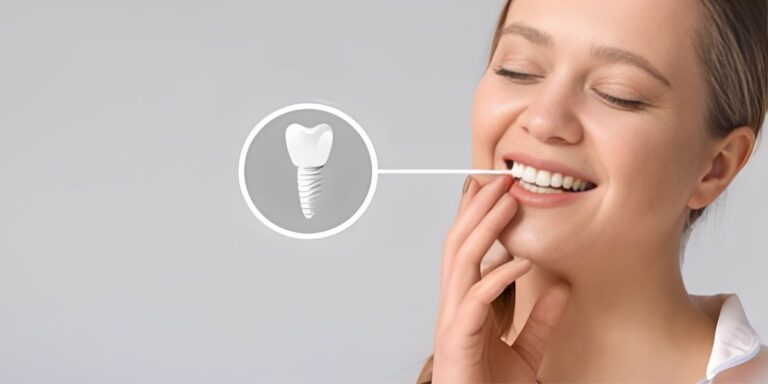
A dental implant works by fusing with the jawbone to act as an artificial tooth root. The implant has 3 parts: the fixture, the abutment and the crown. The fixture is a screw made of commercially pure titanium, most often Grade 4. It sits inside the jawbone where the natural root used to be.
After placement, bone cells grow directly onto the roughened titanium surface. Per-Ingvar Brånemark named this process osseointegration in 1952. In conventional loading, the bond forms over 3–6 months. Immediate loading is used when the implant has high primary stability. Excess micromotion during healing forms fibrous tissue (fibrous encapsulation) instead of bone.
Once the fixture is stable, the abutment connects to it with a small screw. The abutment passes through the gum and holds the crown. The crown restores the shape, colour and bite of the missing tooth.
The implant also loads the jawbone during chewing. This load slows the bone shrinkage that follows tooth loss. A 2019 systematic review by Howe, Keys and Richards in the Journal of Dentistry pooled 18 prospective studies. It found 96.4% of implants still in place after 10 years. A sensitivity analysis that accounted for patients lost to follow-up gave 93.2%. Survival means the implant is still present, not that it is complication-free.
Who Is an Ideal Candidate for a Dental Implant?
An ideal candidate for a dental implant is an adult with a missing tooth, healthy gums and enough jawbone to hold the implant. The 9 characteristics of a good candidate are listed below:
- Age: adults whose jaw growth has finished, with no upper age limit.
- Missing teeth: one tooth, several teeth or a full arch.
- Failing teeth: a tooth that cannot be saved and needs extraction.
- Gum health: gums free of active periodontitis.
- Bone volume: enough bone on the CBCT scan for the planned implant (about 10 mm height and 6 mm width as a general guide), or suitability for a bone graft.
- General health: stable health with controlled conditions.
- Diabetes control: well-controlled blood sugar (HbA1c in the target range set by the physician).
- Smoking status: non-smokers or patients willing to stop around surgery.
- Denture or bridge wearers: patients unhappy with loose dentures or a failing bridge.
Who Should Avoid or Delay a Dental Implant?
The 8 groups who should avoid or delay a dental implant are patients with active gum disease, uncontrolled diabetes, heavy smoking, severe untreated bone loss, high-dose IV bisphosphonates, recent head and neck radiotherapy, growing teenagers and pregnant women. Gum disease, diabetes, smoking and bone loss are treated or controlled first. Teenagers wait until jaw growth finishes, and pregnant women wait until after delivery. Anti-resorptive medicines such as bisphosphonates (zoledronic acid) and denosumab raise the risk of medication-related osteonecrosis of the jaw (MRONJ). Untreated teeth grinding (bruxism) overloads the implant, so a night guard is planned first.
How to Prepare for Dental Implant Surgery?
To prepare for dental implant surgery, share your full medical history, treat any gum disease and stop smoking at least 2 weeks before. The 7 preparation steps are listed below:
- Share every medicine you take, especially blood thinners (warfarin, clopidogrel) and bone medicines (alendronate). Do not stop or change a prescribed blood thinner without advice from the prescribing doctor.
- Complete the 3D CBCT scan and review the written treatment plan.
- Treat gum disease and tooth decay before the implant visit.
- Stop smoking at least 2 weeks before surgery.
- Take any prescribed antibiotics or chlorhexidine mouthwash as directed.
- Eat a light meal before a local-anaesthesia appointment, unless you are having sedation, which needs fasting.
- Stock soft foods (yogurt, soup, mashed potatoes) for the first week.
How Is a Dental Implant Placed at The Master Dentist Islamabad?
A dental implant is placed in 8 steps, with surgery taking 45–60 minutes per implant under local anaesthesia. The full process takes 3–6 months because the bone needs time to fuse with the implant.
Step 1: Consultation and 3D CBCT Scan
The dental surgeon examines the teeth and gums. A cone-beam CT (CBCT) scan measures bone height, width and density. The scan also maps the inferior alveolar nerve and the maxillary sinus.
Step 2: Digital Treatment Planning
The dental surgeon plans the implant size, angle and position on the scan. A surgical guide is made for guided implant surgery when the case needs it. You receive a written quote at this stage.
Step 3: Gum Treatment or Tooth Extraction
Active gum disease and decay are treated first. A failing tooth is removed. The implant goes in at the same visit (immediate implant) or after 6–8 weeks of socket healing.
Step 4: Local Anaesthesia and Implant Placement
Local anaesthesia numbs the area. The dental surgeon opens a small flap in the gum and prepares the bone with sequential drills under cooling. The titanium fixture is inserted with a torque-controlled wrench. Stitches close the gum.
Step 5: Healing and Osseointegration
The bone fuses with the implant over 3–6 months. Upper-jaw implants and grafted sites need the longer end of this range. A temporary tooth fills front-tooth gaps during healing.
Step 6: Abutment Placement and Impression
The dental surgeon connects the abutment to the healed implant. A digital or traditional impression is taken. The dental laboratory matches the crown shade to the neighbouring teeth.
Step 7: Crown Fitting
The final crown is screwed or cemented onto the abutment. The dental surgeon checks the bite and adjusts it.
Step 8: Review and Maintenance Visits
Review visits check the gum and bone around the implant. Professional cleaning follows every 6 months.
What Is the Aftercare After a Dental Implant?
Dental implant aftercare is eating soft food for 1 week, keeping the area clean and avoiding smoking for at least 8 weeks. The 8 aftercare instructions are listed below:
- Eat soft food and chew on the opposite side for 1 week.
- Apply a cold compress for 10–15 minutes at a time during the first 24–48 hours.
- Rinse gently with warm salt water from the day after surgery.
- Take painkillers (ibuprofen, paracetamol) and antibiotics as directed by your dental surgeon.
- Avoid smoking for at least 8 weeks.
- Clean around the implant daily with an interdental brush or implant floss.
- Wear a night guard if you grind your teeth.
- Attend a check-up and professional cleaning every 6 months.
Food collects around an implant crown the same way it does around natural teeth. Daily interdental cleaning removes it and protects the gum seal.
Which Dental Implant Treatments Are Offered at The Master Dentist Islamabad?
The Master Dentist offers 5 dental implant treatments, from a single tooth implant to full-arch All-on-4 and All-on-6, supported by 2 techniques: guided implant surgery and bone grafting. All 5 treatments use endosteal implants placed inside the jawbone.
| Treatment or Technique | What It Involves | Best For |
|---|---|---|
| Single Tooth Implant | 1 implant and 1 crown | One missing tooth |
| Implant-Supported Bridge | 2 implants hold a 3- or 4-tooth bridge | Several missing teeth in a row |
| All-on-4 and All-on-6 | 4–6 implants hold a fixed full-arch bridge | All teeth missing in one jaw |
| Implant-Retained Denture | 2–4 implants hold a removable overdenture | Loose lower dentures |
| Immediate (Same-Day) Implant | Implant placed at the extraction visit | A failing tooth with good bone |
| Guided Implant Surgery (technique) | Computer-planned surgical guide | Precise placement near nerves or the sinus |
| Bone Grafting and Sinus Lift (technique) | Bone added before or during placement | Thin bone or a low sinus |
Implant systems range from Korean options (Osstem, Dentium, DIO) to Swiss and US options (Straumann, BioHorizons). Crowns are made from zirconia, E-max or porcelain-fused-to-metal (PFM).
How Long Does the Dental Implant Process Take?
The dental implant process takes 3–6 months from placement to the final crown, with surgery taking 45–60 minutes per implant. A bone graft adds 3–6 months.
| Stage | Timeline | What To Expect |
|---|---|---|
| Consultation and CBCT | Day 1 | Examination, scan and written plan |
| Socket healing (if extracted) | Same day or 6–8 weeks | Immediate implant or healing before placement |
| Implant placement | 45–60 minutes per implant | Local anaesthesia, stitches |
| Initial gum healing | 1–2 weeks | Soreness settles in 2–3 days; stitches removed |
| Osseointegration | 3–6 months | Bone fuses with the implant |
| Abutment, impression and crown | 1–3 weeks | Final tooth fitted and bite adjusted |
You can bite into an apple once the final crown is fitted. Avoid hard food on the implant side before then.
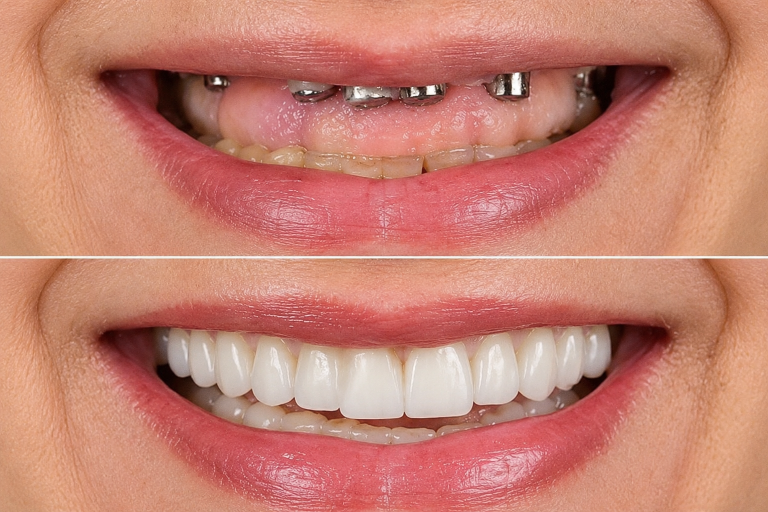
Dental Implant Before and After
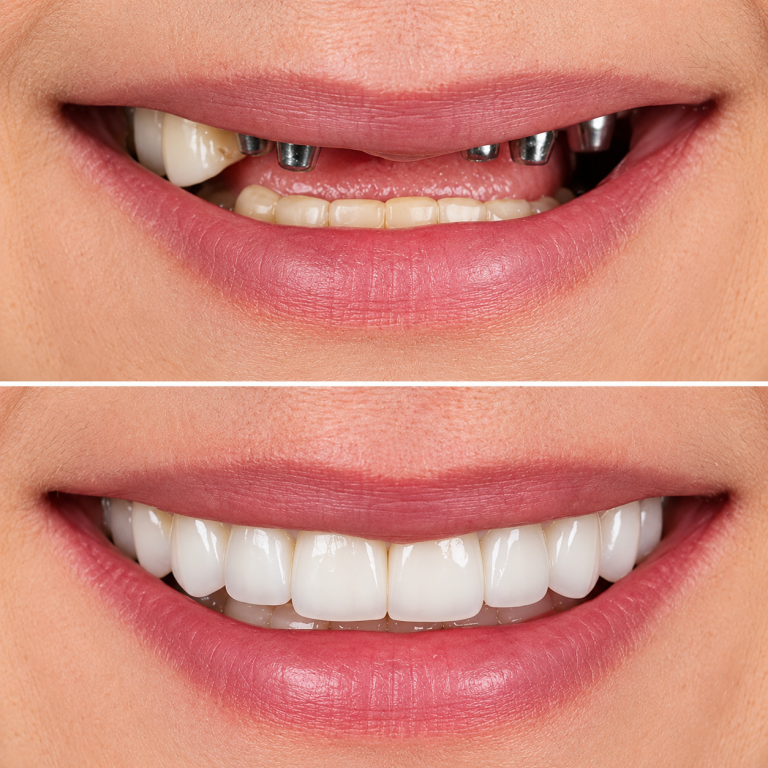
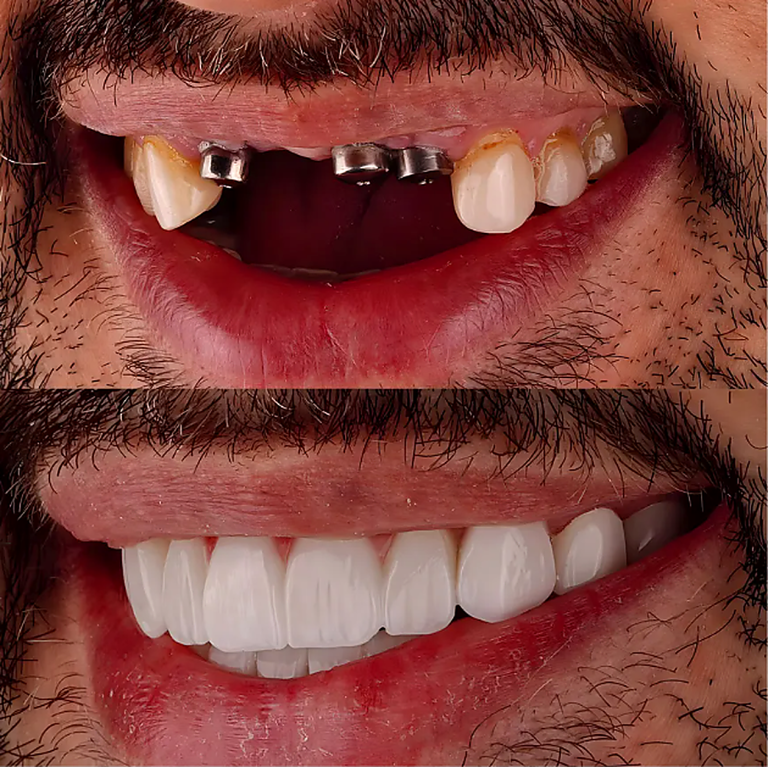
These before-and-after photos show missing teeth and exposed implant abutments restored with fixed implant crowns and bridges. Results vary from person to person.
How Long Do Dental Implants Last?
A dental implant fixture is a long-term restoration: 96.4% of implants remain after 10 years, and the crown lasts 10–15 years. This figure comes from Howe et al. (2019, Journal of Dentistry, 18 prospective studies). The 4 factors that shorten implant life are poor daily cleaning, smoking, untreated teeth grinding and missed check-ups. A 2024 meta-analysis by Kupka and colleagues in Clinical Oral Investigations reported about 4 in 5 implants surviving at 20 years.
What Are the Benefits of Dental Implants?
The 10 benefits of dental implants are listed below:
- Natural appearance: the crown matches the shape and shade of nearby teeth.
- Full chewing power: the implant handles normal biting forces once healed.
- Fixed tooth: the implant stays in place and needs no removal at night.
- Jawbone protection: chewing load on the implant slows bone shrinkage.
- No cutting of neighbouring teeth: a single implant leaves adjacent teeth untouched, unlike a bridge.
- Clear speech: a fixed tooth does not slip like a loose denture.
- Facial support: preserved bone at the implant site helps maintain lower-face support.
- Easy cleaning: the implant is brushed and flossed like a natural tooth.
- Long service life: 96.4% of implants remain after 10 years (Howe et al., 2019).
- Support for multiple teeth: 4–6 implants hold a full fixed arch.
What Are the Side Effects and Risks of Dental Implants?
The 3 most common side effects of dental implants are mild soreness for 2–3 days, swelling and bruising for 2–5 days, and minor bleeding in the first 24 hours. The 7 less common risks are listed below:
- Infection at the implant site.
- Peri-implantitis: gum inflammation with bone loss around the implant, reported in about 10% to 40% of patients across studies.
- Nerve injury: numbness of the lower lip or chin after a lower-jaw implant.
- Sinus perforation after an upper-jaw implant.
- Failure to integrate: the bone does not fuse with the implant.
- Loose abutment screw.
- Chipped crown.
Early implant failure (in the first months) is mainly a lack of osseointegration caused by infection, smoking or poor primary stability. Late failure is mainly peri-implantitis from poor oral hygiene, and overload from teeth grinding. CBCT planning and 6-monthly check-ups lower these risks. Contact your dental surgeon if swelling increases after day 3, bleeding continues, pus appears or the implant feels loose.
Dental Implant vs Bridge vs Denture vs Root Canal – Which Is Better?
The better option depends on bone volume, general health, the number of missing teeth and budget. A dental implant suits long-term replacement of a missing tooth, while a root canal saves a natural tooth that is still restorable.
| Factor | Dental Implant | Dental Bridge | Denture | Root Canal + Crown |
|---|---|---|---|---|
| How it works | Titanium root in the bone with a crown | Crown units fixed to the 2 neighbouring teeth | Removable plate with artificial teeth | Cleans and seals the existing root |
| Best for | Missing teeth with enough bone | Missing tooth with crowned neighbours | Many missing teeth on a budget | A damaged but restorable tooth |
| Effect on neighbours | None | Neighbouring teeth are trimmed | Partial denture clasps rest on nearby teeth | None |
| Jawbone protection | Yes | No | No | Yes (natural root stays) |
| Treatment time | 3–6 months | 2–3 weeks | 2–4 weeks | 1–3 visits |
| Lifespan | 96.4% of implants at 10 years; crown 10–15 years | 7–15 years | 5–10 years | Many years when crowned and maintained |
Choose a bridge or denture when the jawbone or health rules out surgery. Choose a root canal when the tooth is restorable.
Dental Implants in Islamabad for Overseas Pakistanis
Overseas Pakistanis complete dental implants in Islamabad in 2 trips, 3–6 months apart. The 4 parts of the plan are listed below:
- Before travel: share an OPG or CBCT scan for a written quote.
- Trip 1 (about 1 week): consultation, CBCT scan and implant placement.
- Healing at home (3–6 months): a temporary tooth fills front-tooth gaps.
- Trip 2 (4–5 days): abutment, impression and final crown.
An immediate implant at extraction saves a separate healing period when the bone allows it.
Why Choose The Master Dentist Islamabad for Dental Implants?
The Master Dentist plans dental implants after a full examination and scan, with a written treatment plan and quote. The 7 reasons patients choose The Master Dentist for implants are listed below:
- Qualified dental surgeon: Dr. Asad Nawaz Baloch, BDS, RDS (School of Dentistry, SZABMU, Islamabad).
- 3D CBCT planning: the scan maps bone, nerves and sinus before surgery.
- Guided implant surgery: a surgical guide transfers the digital plan to the mouth.
- Choice of implant systems: Korean and Swiss or US options to match the case and budget.
- Written quotes: the quote lists the implant, abutment, crown and any graft before treatment.
- Overseas patient plan: 2-trip scheduling with a temporary tooth.
- Maintenance programme: 6-monthly implant check-ups and cleaning.
Dental Surgeon for Dental Implants at The Master Dentist Islamabad
Dr. Asad Nawaz Baloch, BDS, RDS – Dental Surgeon
Dr. Asad Nawaz Baloch is a Dental Surgeon at The Master Dentist, Islamabad. He holds a Bachelor of Dental Surgery (BDS) degree. He completed his Residency in Dental Surgery (RDS) at the School of Dentistry, Shaheed Zulfiqar Ali Bhutto Medical University (SZABMU), Islamabad.
Dr. Asad Nawaz Baloch evaluates each patient’s dental concerns before recommending a treatment option. For dental implants, his assessment covers the gums, the jawbone and the patient’s medical history. He explains each option clearly and builds a personalised treatment plan with the patient.
His approach focuses on 3 things: patient comfort, clear communication and precise clinical work. At The Master Dentist, he helps patients restore missing teeth and maintain a healthy smile.
Book a Dental Implant in Islamabad
Book an implant assessment at The Master Dentist, Islamabad. The consultation includes an oral examination, a CBCT scan if needed and a written treatment plan with cost. Call or WhatsApp +92 340 5599322.
Dental Implant FAQs
Is getting a dental implant painful?
Dental implant surgery is not painful during the procedure because local anaesthesia numbs the area. You feel pressure but not sharp pain. Mild soreness lasts 2–3 days and settles with painkillers.
Can a dental implant be done in one day?
Yes, an implant can be placed on the same day as the extraction when the CBCT scan shows enough bone for primary stability. The final crown still follows after 3–6 months of healing.
Which type of tooth implant is best?
The best tooth implant is a titanium endosteal implant from an established system, chosen for your bone and budget. Straumann and BioHorizons cost more; DIO and Osstem offer recognised lower-cost options.
Can I get a dental implant if I have bone loss?
In most cases, yes, you can get a dental implant with bone loss after a bone graft or sinus lift rebuilds the bone. Severe bone loss sometimes rules out grafting. Grafting adds 3–6 months of healing before or during implant placement.
Can diabetics get dental implants?
Yes, diabetics can get dental implants when their blood sugar is well controlled. Uncontrolled diabetes slows healing and raises the risk of infection and peri-implantitis.
Can smokers get dental implants?
Yes, smokers can get dental implants, but smoking raises the failure risk. Stop at least 2 weeks before surgery and stay smoke-free for at least 8 weeks after.
Will I have a gap while my implant heals?
No, front teeth are not left with a gap because a temporary tooth is fitted during the 3–6 month healing period. Back-tooth gaps are often left open to protect the implant.
What is cheaper than a tooth implant?
A dental bridge or a removable denture is cheaper than a tooth implant upfront. Both need replacing more often and do not protect the jawbone.
Are dental implants safe for MRI?
Yes, titanium dental implants are safe for MRI because titanium is non-ferromagnetic. Metal crowns can cause image artefacts, so tell the radiographer about your implant. Implants do not set off airport security scanners.
Can a dental implant get cavities?
No, a dental implant cannot get cavities because titanium and ceramic crowns do not decay. The gum around the implant still needs daily cleaning to prevent peri-implantitis.
Is a tooth extraction more painful than an implant?
A tooth extraction and implant placement cause similar discomfort, because both use local anaesthesia. Soreness after either procedure lasts 2–3 days in most cases. A difficult extraction causes more swelling than a straightforward implant.
Does your gum heal over the implant screw?
Yes, the gum heals over the implant when a cover screw is used in two-stage surgery. A small uncovering visit exposes the implant before the abutment goes on. In one-stage surgery, a healing cap stays visible through the gum.
How can I afford a dental implant in Islamabad?
To afford a dental implant, compare implant systems, ask for a written quote and pay in stages where the clinic allows it. Korean implant systems cost less than Swiss and US systems.
What are mini dental implants?
Mini dental implants are narrow one-piece implants under 3 mm wide, used mainly to hold a lower denture. They suit thin bone but carry less chewing load than standard implants.