Composite Veneers at The Master Dentist Islamabad
Composite veneers fix chipped, gapped, stained and uneven front teeth in a single visit, with little or no drilling. They suit teens and adults who want a natural smile makeover at a lower cost than porcelain. Book a smile consultation at The Master Dentist in Islamabad to plan your composite veneers.
Composite veneers are a cosmetic dental treatment that bonds tooth-colored composite resin to the front surface of teeth. In the direct technique, the dentist etches the enamel, applies a bonding agent and sculpts the resin by hand. A blue curing light hardens each layer in 10-20 seconds. Indirect composite veneers are made in a dental laboratory and bonded at a second visit. The procedure has 8 steps: consultation, shade selection, cleaning, etching and bonding, layering, curing, polishing and aftercare. Composite veneers suit people with healthy teeth and gums and minor cosmetic flaws. There is no downtime, and you return to work the same day. Results show immediately after the final polish.
Composite veneers at The Master Dentist are placed by Dr. Asad Nawaz Baloch, Dental Surgeon (B.D.S., R.D.S., School of Dentistry, SZABMU, Islamabad).
Quick Facts
| Fact | Detail |
|---|---|
| Procedure Cost | Starts from PKR 10,000 per tooth |
| Procedure Time | 30-60 minutes per tooth |
| Visits | 1 visit (direct), 2 visits (indirect) |
| Anesthesia | Usually not needed |
| Recovery | No downtime; mild sensitivity usually settles within 1 week |
| Results | Immediate |
| Results Last | 3-10 years, depending on care and habits |
What Is the Price of Composite Veneers at The Master Dentist Islamabad?
Composite veneers at The Master Dentist cost PKR 10,000 to PKR 30,000 per tooth. Direct composite veneers cost less than indirect, lab-made composite veneers. The total price equals the per-tooth price multiplied by the number of teeth treated. For example, 4 direct composite veneers start from PKR 40,000.
The 4 factors that affect the cost of composite veneers are listed below:
- Technique: direct chairside veneers cost less than indirect lab-made veneers.
- Number of teeth: the total rises with each tooth treated in a 2-tooth, 6-tooth or 10-tooth smile makeover.
- Teeth whitening first: teeth whitening is priced separately and done before the veneers.
- Pre-treatment: fillings for decay, gum treatment or removal of old fillings add to the total.
| Composite Veneer Treatment | Number of Visits | Cost (PKR) |
|---|---|---|
| Composite Bonding (chip or edge repair, per tooth) | 1 | PKR 6,000 – 10,000 |
| Direct Composite Veneer (per tooth) | 1 | PKR 10,000 – 20,000 |
| Indirect Composite Veneer (per tooth) | 2 | PKR 15,000 – 30,000 |
| Composite Veneers for 2 Front Teeth | 1 | PKR 20,000 – 40,000 |
| Composite Veneers Smile Makeover (6 teeth) | 1-2 | PKR 60,000 – 120,000 |
| Composite Veneers Full Smile (8-10 teeth) | 1-2 | PKR 80,000 – 200,000 |
| Composite Veneer Polishing and Repair (per tooth) | 1 | PKR 2,000 – 5,000 |
Who Is an Ideal Candidate for Composite Veneers?
The ideal candidate for composite veneers is a man or woman with healthy teeth and gums who wants to correct minor cosmetic flaws. The 10 characteristics of an ideal candidate are listed below:
- Chipped or broken front teeth
- Small gaps between teeth (diastema)
- Worn or short teeth
- Uneven or slightly crooked teeth
- Stained teeth that do not respond to whitening
- White or brown marks from fluorosis or enamel hypoplasia
- Black triangles between teeth near the gum line
- One tooth smaller than its neighbor, such as a peg lateral incisor
- Preference for a lower-cost alternative to porcelain veneers
- Realistic expectations about shine and lifespan
Who Should Avoid or Delay Composite Veneers?
People with untreated decay, gum disease or heavy teeth grinding delay composite veneers until these problems are treated. The 7 groups who should avoid or delay composite veneers are listed below:
- People with untreated tooth decay
- People with active gum disease or bleeding gums
- People who grind or clench their teeth (bruxism) without a night guard
- People with severe crowding or bite problems, which often need braces or aligners first
- People with large gaps caused by a missing tooth
- People with very little enamel left on the teeth
- People with poor oral hygiene or habits such as nail biting
Your dentist treats decay and gum problems first, then places the veneers.
How to Prepare for Composite Veneers?
To prepare for composite veneers, treat any decay or gum problems, finish teeth whitening and keep your teeth clean before the visit. The 7 preparation steps are listed below:
- Book a consultation and share photos of smiles you like.
- Complete fillings, gum treatment or root canal treatment first if your dentist finds decay or gum disease.
- Finish teeth whitening at least 2 weeks before the veneers, because composite resin does not whiten.
- Book a scale and polish before the visit if your dentist finds plaque or tartar buildup.
- Brush and floss well on the day of the appointment.
- Avoid tea, coffee and paan on the day of the visit.
- Tell your dentist if you grind or clench your teeth.
How Are Composite Veneers Placed at The Master Dentist Islamabad?
Composite veneers are placed in 8 steps over 30-60 minutes per tooth. Several teeth are treated in one longer visit when their shape and shade need to match. Most patients need no injection, because there is little or no drilling.
Step 1: Consultation, Smile Analysis and X-rays
The dentist examines your teeth, gums and bite. X-rays check for hidden decay. The dentist then plans the shape, length and shade of each veneer.
Step 2: Shade Selection
The dentist matches the resin shade to your teeth with a shade guide. Shade is chosen in daylight before the teeth dry out, because dry enamel looks lighter.
Step 3: Tooth Cleaning and Isolation
The dentist cleans the tooth surface with polishing paste. A cheek retractor holds the lips and cheeks away. Cotton rolls and suction keep the teeth dry.
Step 4: Etching and Bonding Agent
The dentist applies about 37% phosphoric acid gel to the enamel for about 15-30 seconds. The gel creates microscopic pores. A bonding agent then flows into these pores to hold the resin.
Step 5: Layering and Sculpting the Composite Resin
The dentist builds the veneer in thin layers. An opaque body layer hides stains. A translucent layer copies the natural incisal edge.
Step 6: Light Curing
A blue curing light hardens each layer in about 10-20 seconds.
Step 7: Shaping, Polishing and Bite Check
The dentist shapes the edges with fine burs and polishing discs. Articulating paper checks that the bite is even.
Step 8: Post-Treatment Care
The dentist explains home care. Avoid very hard foods for about 1 day.
For indirect composite veneers, the dentist takes an impression or digital scan. A dental laboratory makes the veneers, and the dentist bonds them at a second visit about 1 week later.
What Is the Aftercare for Composite Veneers?
Composite veneer aftercare involves gentle daily cleaning, limiting stain-causing drinks and protecting the veneers from hard biting forces. The 8 aftercare instructions are listed below:
- Brush twice daily with a soft toothbrush and non-abrasive fluoride toothpaste.
- Floss once daily.
- Rinse with water after tea, coffee, cola or paan.
- Avoid smoking and tobacco.
- Avoid biting nails, pens, thread or packets.
- Cut hard foods such as apples into pieces and chew them with your back teeth.
- Wear a night guard if you grind your teeth.
- Visit every 6 months for a check-up and polish.
Avoid whitening toothpastes and charcoal powders, because their abrasives scratch the resin surface.
Which Types of Composite Veneers Are Offered at The Master Dentist Islamabad?
The Master Dentist offers 3 types of composite veneers: direct composite veneers, indirect composite veneers and composite bonding (partial veneers). The 3 types are listed below:
- Direct composite veneers: resin sculpted on the tooth in 1 visit.
- Indirect composite veneers: veneers made in a dental laboratory and bonded at a second visit.
- Composite bonding (partial veneers): resin added to one part of the tooth, such as a chipped corner or short edge.
All 3 types treat 4 common concerns: small gaps (diastema) and black triangles, chipped and worn edges, stains from fluorosis or old fillings, and uneven tooth size or shape.
How Long Do Composite Veneers Last?
Composite veneers last 3-10 years, depending on care, bite and habits. Porcelain veneers last 10-15 years for comparison. The 4 factors that shorten the life of composite veneers are teeth grinding, biting hard objects, smoking and skipping check-ups. Polishing at every 6-month check-up restores the shine. Small chips are repaired by adding fresh resin. The surface layer is renewed when polishing no longer removes stains. These touch-ups extend the life of the veneers without replacing them.
What Results Can You Expect From Composite Veneers?
Composite veneers give an immediate result, with teeth that look even, whiter and gap-free when the polish is complete. The timeline below shows what to expect over hours, weeks and years:
| Timeline | What to Expect |
|---|---|
| Immediately (same visit) | Teeth look even, whiter and gap-free |
| First 24-48 hours | Mild sensitivity to hot and cold; the tongue adjusts to the new shape |
| First week | Sensitivity settles and the bite feels normal |
| Every 6 months | Check-up and polish to remove surface stains and restore shine |
| 3-10 years | Touch-up, resurfacing or replacement as needed |
A 2024 randomized clinical trial from Prince Sattam Bin Abdulaziz University was published in the journal Materials. It treated 28 patients with multiple diastema closure. The patients received 60 direct composite veneers and 60 e.max ceramic veneers. After 2 years, 93.4% of composite veneers and 95% of ceramic veneers survived, with no significant difference. Composite veneers showed more staining and surface roughness.
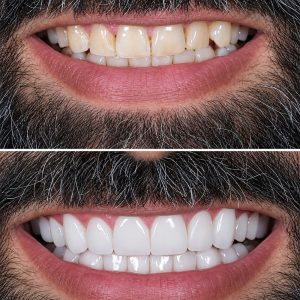
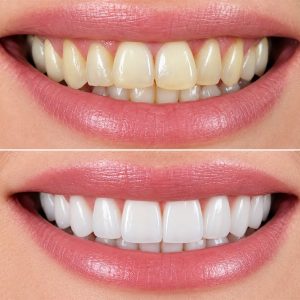
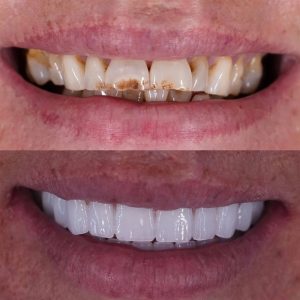
Composite Veneers Before and After
The gallery shows real patients of The Master Dentist Islamabad treated for gaps, chipped front teeth, stained teeth and worn edges. Each caption names the concern and the number of teeth treated. Results vary from person to person.
What Are the Benefits of Composite Veneers?
The 10 benefits of composite veneers are listed below:
- Little or no enamel removal: the resin bonds to the existing tooth surface.
- One visit: direct veneers are completed in a single appointment.
- Lower cost: composite veneers cost less per tooth than porcelain veneers.
- Natural color: the resin shade is matched to your own teeth.
- Several fixes at once: one veneer corrects a chip, a gap and a stain together.
- No injection in most cases: little or no drilling is needed, although deep chips or decay removal can need local anesthesia.
- Largely reversible: when little or no enamel was prepared, the resin can be polished off with minimal enamel loss.
- Easy repair: a chip is fixed by adding resin instead of making a new veneer.
- Refreshable surface: polishing at each 6-month check-up restores shine.
- Trial option: composite lets you test a new smile shape before porcelain.
What Are the Side Effects and Disadvantages of Composite Veneers?
The 3 most common side effects of composite veneers are temporary sensitivity, staining and edge chipping. The 7 common side effects and disadvantages are listed below:
- Sensitivity to hot and cold that usually settles within 1 week
- A new feel for the tongue and lips for 1-2 days
- Staining from tea, coffee, paan and smoking over time
- Loss of surface shine
- Chipping at the biting edge
- A visible line where the resin meets the tooth
- A shorter lifespan than porcelain
Rare side effects include debonding, gum irritation, bite discomfort and decay at the margin.
A 2023 systematic review by Lim, Tan, Li and Burrow in the Journal of Evidence-Based Dental Practice pooled 7 studies of composite laminate veneers. Surface roughness, color mismatch and marginal discoloration were the most reported complications. Most complications were clinically acceptable with or without a touch-up. Polishing or adding resin fixes most of these issues. Choose porcelain veneers if maximum stain resistance and lifespan matter most to you.
Contact your dentist if sensitivity lasts longer than 1 week, if biting feels uneven or if a piece of the veneer breaks off.
Composite Veneers vs Porcelain Veneers vs Composite Bonding vs Dental Crowns: Which Is Better?
Composite veneers are better for an affordable, reversible smile makeover in one visit, while porcelain veneers are better for maximum lifespan and stain resistance. The table compares the 4 options:
| Factor | Composite Veneers | Porcelain Veneers | Composite Bonding | Dental Crowns |
|---|---|---|---|---|
| Material | Composite resin | Porcelain or e.max ceramic | Composite resin | Zirconia, porcelain or metal-ceramic |
| Tooth reduction | Little or none | Thin enamel layer | None or minimal | Most of the outer tooth |
| Visits | 1 (direct) or 2 (indirect) | 2 or more | 1 | 2 |
| Best for | Chips, gaps, stains and shape on several teeth | Large color and shape changes | One small chip or edge | Broken or heavily filled teeth |
| Stain resistance | Lower | High | Lower | High |
| Repairability | Easy, resin added | Usually replaced | Easy, resin added | Usually replaced |
| Reversibility | Largely reversible | Not reversible | Largely reversible | Not reversible |
| Lifespan | 3-10 years | 10-15 years | 3-10 years | 10-15 years, depending on material |
| Cost | Lower | Higher | Lowest | Higher |
Choose composite veneers for a quick, budget-friendly change to several front teeth. Choose composite bonding for one small chip. Choose porcelain veneers for the longest-lasting, most stain-resistant result. Choose a dental crown when a tooth is broken or heavily filled.
Why Choose The Master Dentist Islamabad for Composite Veneers?
The Master Dentist Islamabad offers composite veneers planned by a PM&DC-registered dentist with transparent per-tooth pricing. The 8 reasons to choose The Master Dentist for composite veneers are listed below:
- Qualified Dental Surgeon: Dr. Asad Nawaz Baloch with B.D.S. and R.D.S. qualifications.
- Pre-treatment assessment: smile analysis and X-ray check before treatment.
- Natural shade matching: daylight shade matching for a natural color.
- Layered technique: layered composite technique with an opaque body and a translucent edge.
- Transparent pricing: written treatment plan with the per-tooth price before you start.
- Comprehensive oral care: decay and gum problems treated first in the same clinic.
- Strict hygiene: sterilized instruments for every patient.
- Ongoing maintenance: 6-month polishing and check-up visits.
The Master Dentist Islamabad Dentist for Composite Veneers
Dr. Asad Nawaz Baloch – Dental Surgeon at The Master Dentist
Dr. Asad Nawaz Baloch is a dedicated and compassionate Dental Surgeon at The Master Dentist, committed to delivering quality dental care through a patient-centered approach. He holds a Bachelor of Dental Surgery (B.D.S.) degree and has completed his Residency in Dental Surgery (R.D.S.) from the prestigious School of Dentistry, Shaheed Zulfiqar Ali Bhutto Medical University (SZABMU), Islamabad.
With a strong academic foundation and specialized clinical training, Dr. Asad Nawaz Baloch brings extensive dental knowledge and a comprehensive understanding of oral healthcare. He focuses on carefully evaluating each patient’s dental concerns, recommending appropriate treatment options, and providing care with professionalism, precision, and attention to detail.
His approach combines clinical knowledge with a genuine commitment to patient comfort, clear communication, and personalized treatment planning. At The Master Dentist, he strives to help patients maintain healthier smiles and enjoy a comfortable, reassuring dental care experience.
Book Composite Veneers in Islamabad
Book a composite veneers consultation at The Master Dentist, Islamabad. The consultation includes a dental examination, X-rays if needed, a shade check and a written per-tooth quote. Call +92 340 5599322 or message us on WhatsApp.
Composite Veneers FAQs
Is it painful to get composite veneers?
Getting composite veneers causes little or no pain for most patients. There is little or no drilling, so most patients need no injection. Mild sensitivity to hot and cold usually settles within 1 week.
How long do composite veneers take?
Direct composite veneers take 30-60 minutes per tooth in 1 visit. Indirect composite veneers take 2 visits about 1 week apart, because a dental laboratory makes them.
Are composite veneers worth it?
Whether composite veneers are worth it depends on your concern, budget and expected lifespan. For chips, gaps and stains on front teeth, they cost less than porcelain, take 1 visit and remove little or no enamel. Porcelain gives a longer lifespan.
How much would 12 composite veneers cost?
12 composite veneers cost PKR 120,000 to PKR 360,000 at The Master Dentist. The total depends on direct or indirect technique and any treatment needed first.
Do composite veneers damage your natural teeth?
No, composite veneers do not damage natural teeth when placed correctly. The resin bonds to the enamel with little or no drilling. Poor hygiene, a sugary diet or a leaking margin raises the risk of decay at the edge.
Can composite veneers be removed?
Yes, composite veneers can be removed. When little or no enamel was prepared, the dentist polishes the resin off with minimal enamel loss. This makes the treatment largely reversible.
Can composite veneers be whitened?
No, composite veneers cannot be whitened. Whitening gel lightens natural enamel but not composite resin. Finish teeth whitening at least 2 weeks before your veneers so the shades match.
Do composite veneers stain easily?
Yes, composite veneers stain more easily than porcelain. Tea, coffee, paan and smoking cause surface stains. A polish at every 6-month check-up removes most of them.
Can I bite into an apple with composite veneers?
No, biting directly into an apple with front composite veneers risks chipping the edge. Cut apples and other hard foods into pieces and chew them with your back teeth.
Can composite veneers fix crooked teeth?
Yes, composite veneers can disguise slightly crooked teeth. Severely crooked or crowded teeth need braces or aligners first, because thick resin looks bulky.
Can composite veneers close gaps between teeth?
Yes, composite veneers close small gaps between teeth (diastema) in 1 visit. The dentist adds resin to the sides of the teeth. Large gaps from a missing tooth need an implant or bridge.
Is it halal to get veneers?
Many Islamic scholars consider veneers permissible when they repair a defect such as chipped, stained or gapped teeth. Scholarly views differ, so ask a scholar you trust about your situation.
What do composite veneers look like after 5 years?
After 5 years, composite veneers often show some loss of shine and light surface staining. Polishing restores the gloss, and the dentist renews the surface layer when polishing no longer helps.
Can composite veneers last 20 years?
No, composite veneers rarely last 20 years without touch-ups. Their lifespan is 3-10 years, depending on care, bite and habits. Porcelain veneers last longer.
Which veneers look the most natural?
Porcelain veneers, such as e.max, look the most natural, because ceramic reflects light like enamel and resists staining. Well-layered composite veneers also look natural when they are polished every 6 months.
Can chipped composite veneers be repaired?
Yes, chipped composite veneers can be repaired in 1 visit. The dentist roughens the chipped area, adds fresh resin, cures it and polishes it to match.
Can teeth go bad under composite veneers?
Yes, teeth can decay under composite veneers if plaque collects at the margin. Brushing twice daily, flossing once daily and 6-month check-ups lower this risk.